Tutorial — Sim-to-Real Handoff
This page is about the handoff from sim code to a real backend. It does not ship a hardware driver; it shows the contract that a hardware driver has to satisfy and the pieces that already sit on top of that contract.
Everything here runs against a software skeleton that tracks commanded state in memory. The useful part is the shape of the interface: what a real backend needs to implement, what should carry over unchanged, and what still depends on MuJoCo.
Watch the longer walkthrough
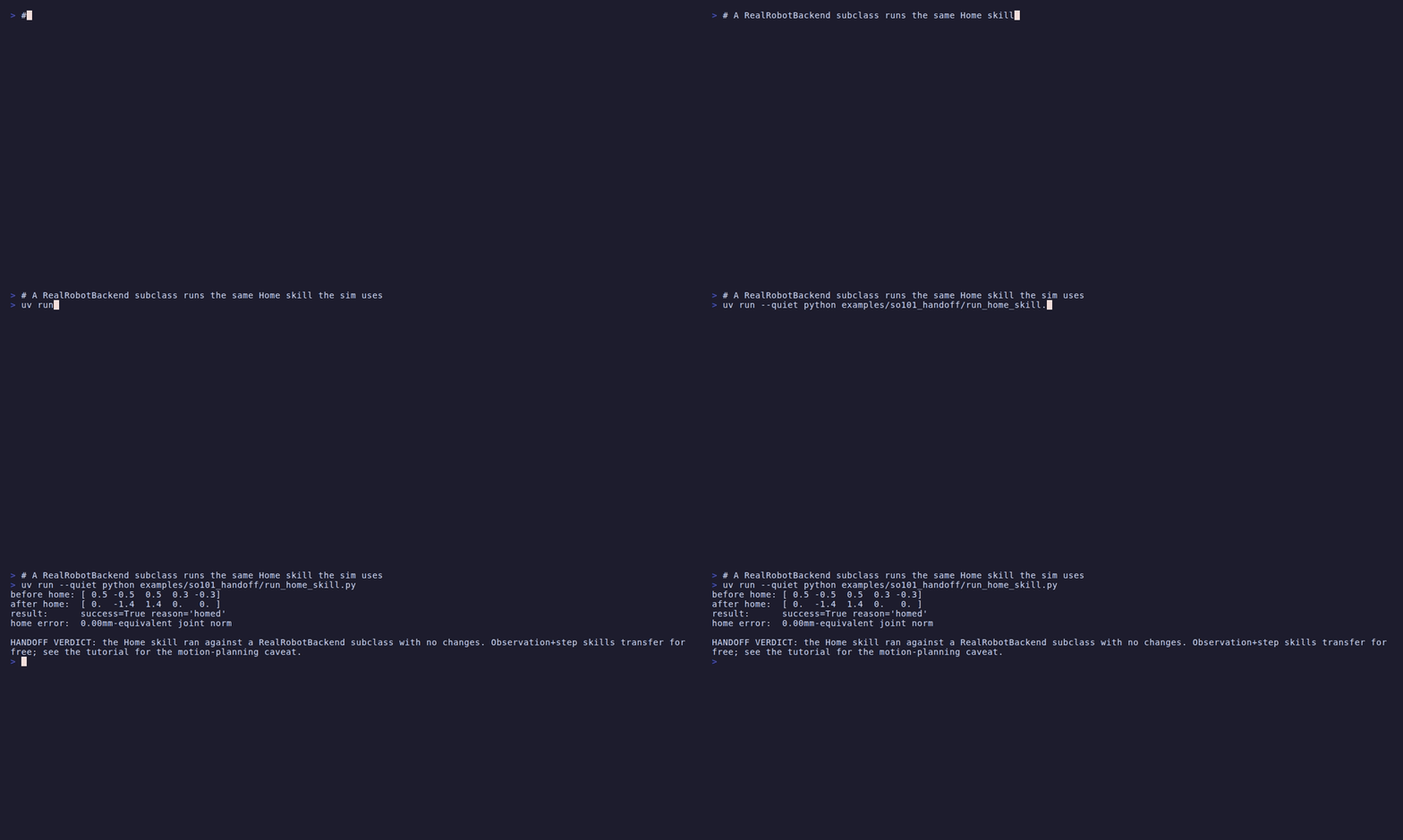
The screenshot above shows the Home skill — the same one the sim uses
— driving a
RealRobotBackend subclass from an arbitrary start pose to its
declared home, with zero joint residual. No branches for
"sim vs real" in the skill; the SimBackend Protocol is the interface.
What carries over
| Layer | Status on RealRobotBackend |
|---|---|
Skill Protocol (name, description, parameters_schema, __call__) |
certified by the contract tests below |
Home skill end-to-end |
certified by test_home_skill_runs_against_real_backend |
Other observation+step skills (Wave, teleop primitives) |
expected to work — same Protocol surface, not individually tested |
LocalRecorder + export-lerobot |
expected to work — reads Observation, which the fake backend produces |
LeRobotPolicyAdapter + run_policy |
expected to work when observation/action dims and camera keys match the policy contract — the runtime loop only calls observe / step, but the adapter still needs the backend's image keys, state dimension, and normalization to line up with what the checkpoint was trained for |
Agent ReAct loop |
expected to work — only composes skill calls + observations |
Here, "certified" means a test in
test_real_backend_contract.py
exercises the path end-to-end against a RealRobotBackend subclass.
"Expected to work" means the layer only consumes the same SimBackend
Protocol surface the certified paths do — verify in your own backend
before relying on it in a production loop.
What you still have to implement
| Method | What your driver does |
|---|---|
load(scene) |
connect to motor bus + camera, run calibration, validate scene workspace bounds |
reset() |
send a blocking trajectory to the configured home pose |
step(target_joints, gripper) |
stream one position command at the configured control rate; clamp against joint + velocity limits |
observe() |
read current joint positions; grab one RGB frame; optionally populate scene_objects from a pose estimator |
get_object_pose(id) |
query your pose estimator (AprilTag, OptiTrack, learned keypoints) — return None if you rely on VLM perception instead |
set_object_pose(id, pose) |
no-op on real hardware; the sandbox only calls it for sim scene init |
close() |
disable torque, release camera, close serial |
What does not carry over
Motion-planning skills (Pick, PlaceOn, Push) depend on
MuJoCo's kinematic model via sim.model / sim.data for their IK
solver. A real-hardware backend won't have those. Options:
- Ship the same URDF into your real backend and expose
model/datacompatible with MuJoCo's Python API (possible withmujoco.MjSpec, but now the sim IS the real backend). - Plan in sim, execute on real: run
Pickagainst a MuJoCo sim to get aJointTrajectory, then stream the waypoints to your real backend'sstep(). This is the mainstream pattern. - Replace the motion planner with one that speaks directly to your robot's native kinematics (e.g. curobo on real URDF).
Home and any observation+step policy can run on either backend
without special branching.
Implementing your SO-101 backend
The skeleton at
examples/so101_handoff/so101_backend.py
is a working starting point with every method stubbed as "echo
commanded state back through observe." Search for _TODO(real) to
find the places where real driver code should go.
Key fields in RealRobotBackendConfig:
RealRobotBackendConfig(
    n_dof=5,                                  # length of target_joints
    joint_names=("Rotation", "Pitch", "Elbow", "Wrist_Pitch", "Wrist_Roll"),
    home_qpos=(0.0, -1.4, 1.4, 0.0, 0.0),
    gripper_open=1.5,                         # jaw radians — widest
    gripper_closed=0.0,                       # jaw radians — pinched
    control_hz=200.0,                         # target tick rate for step()
    safety_bounds=((-0.5, -0.5, 0.0), (0.5, 0.5, 0.8)),
)
Three things are worth preserving when you wire in a real driver:
- Skills read
home_qposviasim.home_qpos(a public property on bothMuJoCoBackendandRealRobotBackend). Removes the per-skill hardcoded home vectors that used to break on any DoF other than 6. LeRobotPolicyAdapterconstructs the same batch shape it does in sim —(1, C, H, W)float32 images,(1, state_dim)float32 state, correct named keys. Policy rollouts whose observation+action dims match your embodiment can be driven with the vanilla adapter viarun_policy.- Regression tests in
packages/robosandbox-core/tests/test_real_backend_contract.pyguard the contract:n_dof/joint_names/home_qposstay consistent,stepmutates observed state, gripper ordering is sane,Homeruns to within 1 mm-equivalent joint norm.
The intended workflow is simple: copy the skeleton, rename the class,
replace the _TODO(real) blocks with calls into your motor bus and
camera, and run the same regression tests against your subclass before
you power the arm.
First real run: safety checklist
Before enabling torque on the arm for the first time with your new backend:
- Joint limits in config match hardware. Read a servo at each
limit with the arm powered off (gravity only); confirm the
joint_names+RealRobotBackendConfigranges match what the motors physically allow. reset()runs without torque. Drive the arm to your declared home manually; runbackend.reset()with torque off; verifyobserve().robot_jointsmatchesbackend.home_qpos± a few counts. Catches sign-flip and zero-offset bugs.- Slow first motion. First step with torque on sends a trajectory to home at ≤ 10% of max velocity. Stand near the E-stop.
- Workspace bounds sanity.
safety_boundsencloses the physical workspace with room to spare. Force a test command that should clamp; verify it does. - Gripper open/closed ordering. Run the
test_gripper_open_width_exceeds_closedstyle check against your backend (seetests/test_real_backend_contract.py): sendgripper=1.0, read width; sendgripper=0.0, read width; the second must be larger. Catches a swappedgripper_open/gripper_closed. Homeskill dry run. With torque on but the arm in open air, runHomefrom its current pose. Zero joint residual is a pass. Any residual = your driver's position controller isn't tracking the commanded trajectory.
Only after those six checks pass should you enable faster motions, teleop, or policy rollouts.
Running it
The zero-hardware skeleton demo is:
Expected output:
before home: [ 0.5 -0.5  0.5  0.3 -0.3]
after home:  [ 0.  -1.4  1.4  0.   0. ]
result:      success=True reason='homed'
home error:  0.00mm-equivalent joint norm
Substitute a real driver by replacing the _TODO(real) blocks in
examples/so101_handoff/so101_backend.py, then run the contract
tests:
If all five pass, the observation+step contract holds for your backend.
That is enough for Home, teleop primitives, custom open-loop skills,
and LeRobotPolicyAdapter-wrapped policies via run_policy. It is not
enough to certify motion-planning skills like Pick, PlaceOn, or
Push; those still depend on MuJoCo kinematics.
Where this fits
- LeRobot Export — proves the data path.
- LeRobot Policy Replay — proves the policy integration.
- Sim-to-Real Handoff (you are here) — the deployment side of the story: what has to happen between a sim-validated skill or policy and real hardware.
Troubleshooting
| Symptom | Likely cause |
|---|---|
ValueError: backend reports n_dof=N but home_qpos has length M |
RealRobotBackendConfig out of sync — joint_names and home_qpos must both match n_dof |
home_dim_mismatch reason from Home |
Your backend's observe().robot_joints.shape[0] != len(home_qpos) — usually a driver returning padded state |
| Gripper closes when you expect open | gripper_open/gripper_closed swapped in config; the open-vs-closed width test catches this |
First step() jerks the arm |
control_hz too low for the distance the controller needs to cover in one tick; prefer smaller joint deltas + higher tick rate |
Pick skill fails with AttributeError: 'MyBackend' object has no attribute 'model' |
Expected — motion planners need MuJoCo kinematics. See "what does NOT carry over" above |